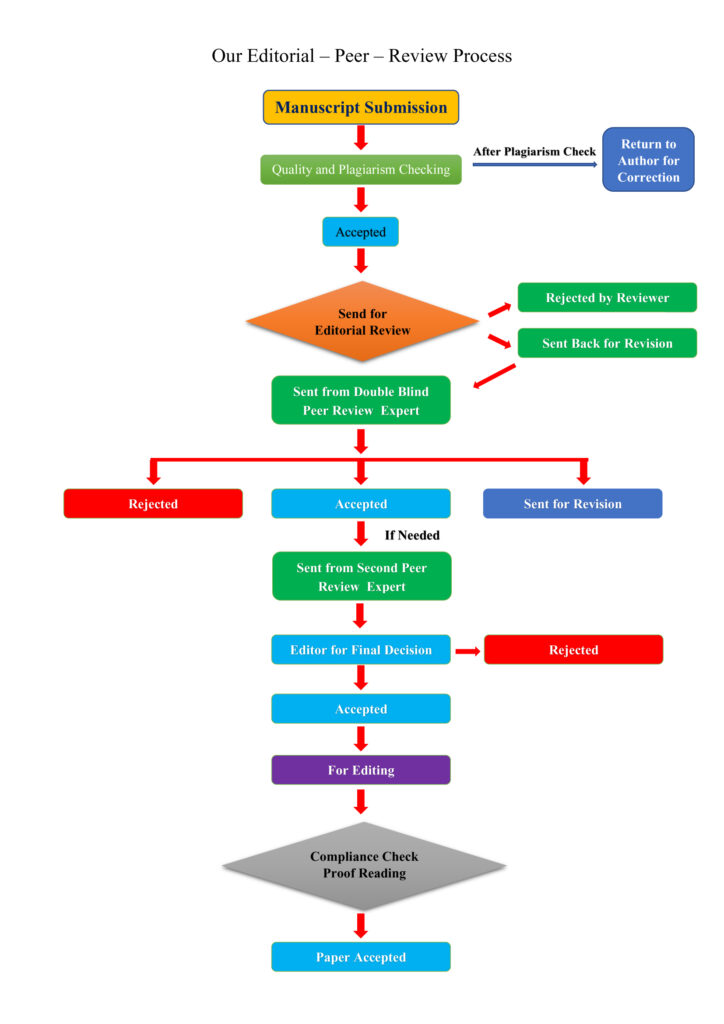
PEER REVIEW AND PUBLICATION PROCESS
1. Editorial Office Assessment
Upon submission, the manuscript is initially assessed by the editorial office to ensure that its structure, organization, formatting, and presentation comply with the journal’s Author Guidelines. The manuscript is also checked for plagiarism or significant textual similarity using appropriate plagiarism-detection and online checking tools. If the manuscript satisfies the initial requirements, it is forwarded to suitable reviewers in the relevant academic field for further evaluation.
2. Reviewer Invitation
The handling editor identifies and invites qualified experts whose research expertise is relevant to the subject matter of the submitted manuscript. If necessary, additional reviewers may be invited until the required number of suitable reviewers has agreed to evaluate the manuscript, generally involving two reviewers.
3. Reviewer Response to Invitation
The invited reviewers assess the manuscript invitation based on their subject expertise, availability, and any potential conflicts of interest. They may accept or decline the invitation. When declining, reviewers may, where appropriate, recommend other qualified experts who could review the manuscript.
4. Peer Review is Conducted
The selected reviewer carefully examines the manuscript to evaluate its quality, originality, relevance, methodology, presentation, and overall academic contribution. The reviewer may read the manuscript several times and prepare detailed comments and recommendations. Based on the assessment, the reviewer submits a review report to the journal along with a recommendation regarding acceptance, revision, or rejection.
5. Editorial Evaluation of Review Reports
After receiving the review reports, the handling editor carefully evaluates the comments and recommendations provided by the reviewers. If the reviewers provide substantially different opinions or additional expertise is required, the editor may invite another qualified reviewer to provide an independent assessment before reaching a final decision.
6. Communication of the Review Decision
The handling editor communicates the review outcome to the corresponding author through the journal’s online submission system or, where necessary, by email. If revisions are required, the author is provided with appropriate comments and a specified period within which to submit the revised manuscript.
7. Second-Round Peer Review
Following the initial peer-review process, a revised manuscript may be returned to the reviewers for further assessment when necessary. The second-round review is conducted to determine whether the authors have adequately addressed the comments and recommendations raised during the first review.
8. Manuscript Editing and Compliance Check
Once the manuscript receives the required approval, the revised version is forwarded to the editorial or editing team for further processing. The manuscript undergoes necessary editorial corrections, formatting, and final preparation. The outcome of the editing process is communicated to the author. If any compliance or technical issues arise during this stage, the manuscript may be referred to the Research and Development team for additional evaluation and final approval.
9. Final Publication Process
After completion of the editorial, review, and compliance procedures, the author receives the official acceptance letter. The manuscript is then prepared for publication, and a galley proof is provided to the author for final verification. Following publication, the author receives the final PDF version of the article containing the assigned DOI and page number.